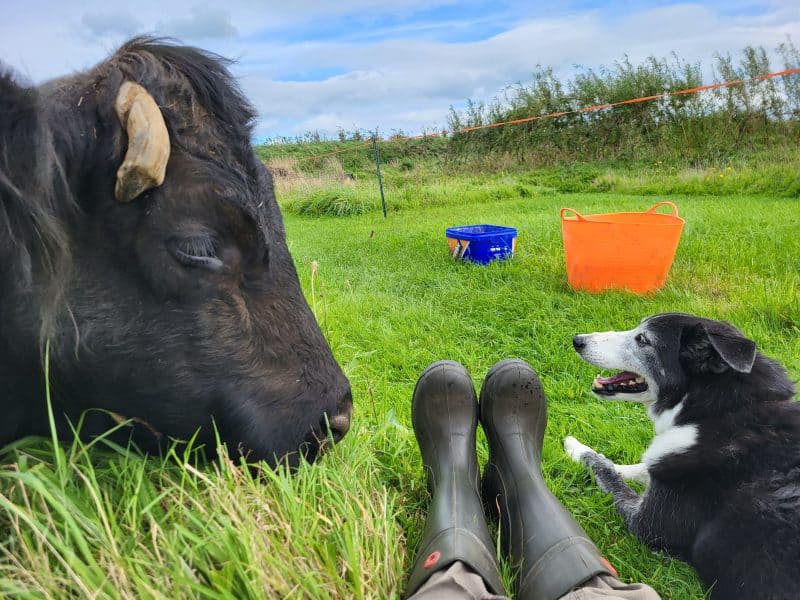
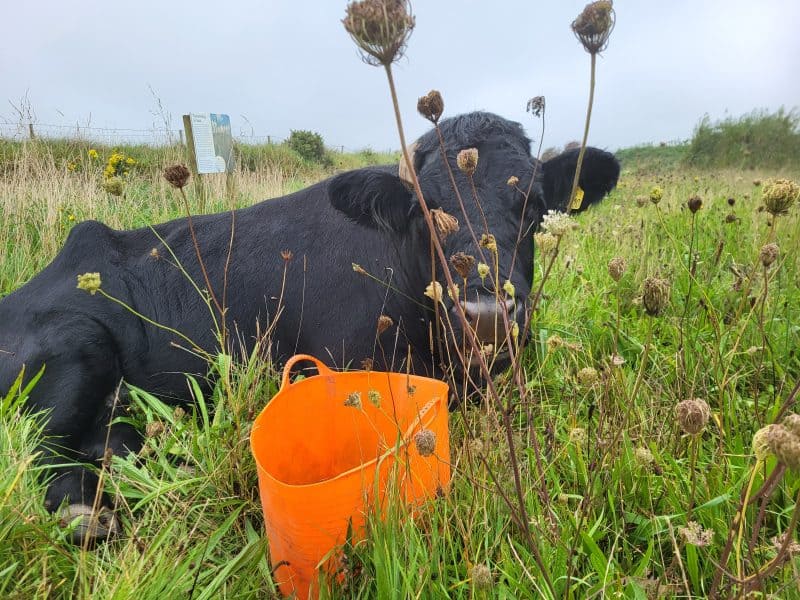
Saving Big B – When you believe in the impossible, miracles may just happen
13 March 2023Posted March 2023
Welsh Black cow Tyddewi Beatrice has, as far as we are aware, become the first large cow in Europe to have life-saving surgery for a common ailment, which could revolutionise the field of farm animal veterinary intervention.
Film courtesy of Richard Coomer, Cotts Equine Hospital.
An international team, consisting of a determined Pembrokeshire farmer who wouldn’t take no for an answer, an equine surgeon willing to take a chance, veterinarians and animal ethics professionals from around the world and a specialist bicycle manufacturer from Oregon came together to save the life of one very special cow, while also pioneering veterinary surgery for farm animals.
When Tyddewi Beatrice the Welsh Black cow (affectionately known as ‘Big B’) fell and damaged her leg in January, it was hoped that she would recover with rest. However, as the weeks went on and she didn’t improve, her owners, Sarah Beynon and Andy Holcroft from The Bug Farm in St Davids got increasingly concerned. Farm vets don’t routinely x-ray the joints of large animals so, under the supervision of the couple’s farm vet Alex Cooper at Fenton Vets, they contacted Cotts Equine Hospital, who had previously x-rayed their calf, Ivy, for them last year with a mobile x-ray kit.
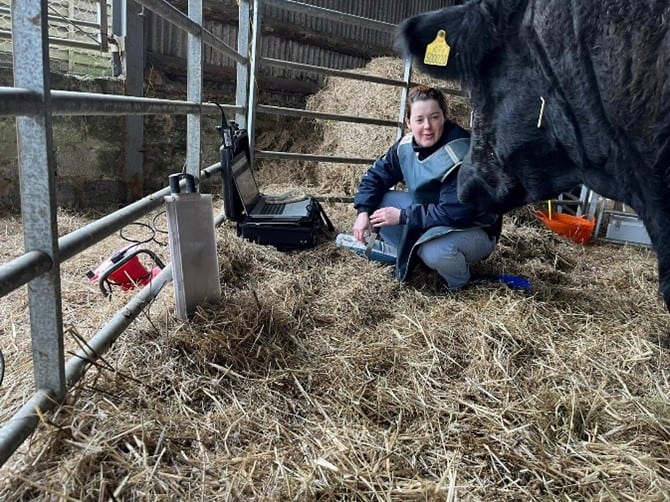
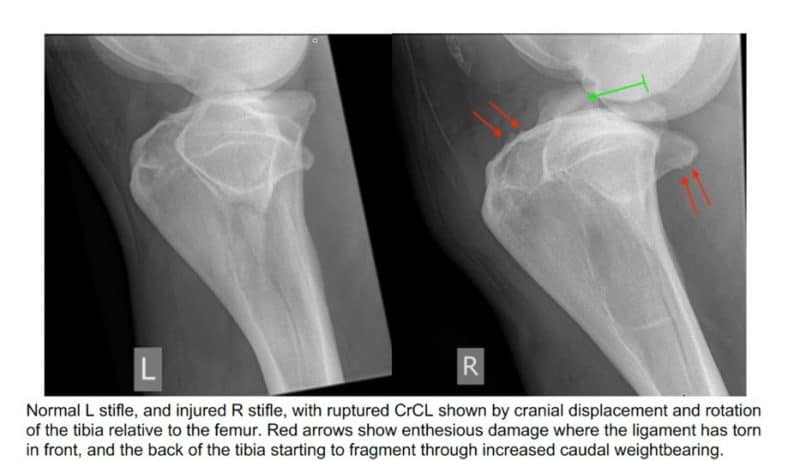
Left: Beatrice meeting Chiara Pressanto while having her stifle x-rayed. Right: The x-ray image of Beatrice’s damaged stifle joint (on the right) (images by Cotts Equine Hospital).
Sarah and Andy’s worst fears were confirmed: Beatrice had completely ruptured the cranial cruciate ligament (CCL) in her back right stifle – what is essentially her knee. This ligament connects the femur to the tibia and, as a result of the injury, Beatrice’s stifle joint had moved out of position, with the tibia having slipped forwards by around 4cm. Beatrice was in significant pain and could not stand on the affected back leg.
The examination report, from specialist equine surgeon Richard Coomer, said: “…In consequence, I have advised that NSAIDs [non-steroidal anti-inflammatories] for a short period followed by euthanasia on humane grounds was sadly the only practical solution”. “The shock you feel when you are given such a diagnosis is significant” said Sarah, Beatrice’s owner. “Our cows are our family members and we would do anything for them. Being told there is nothing you can do is heart-breaking”.
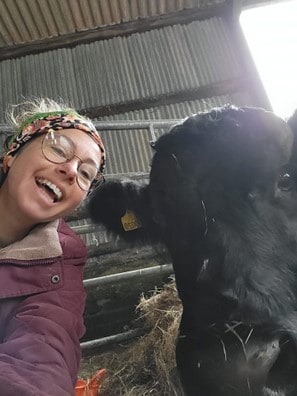
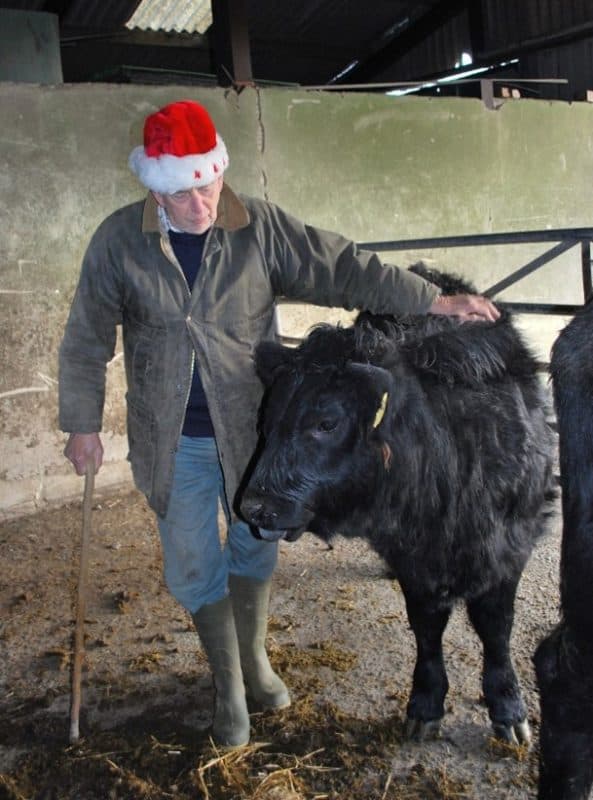
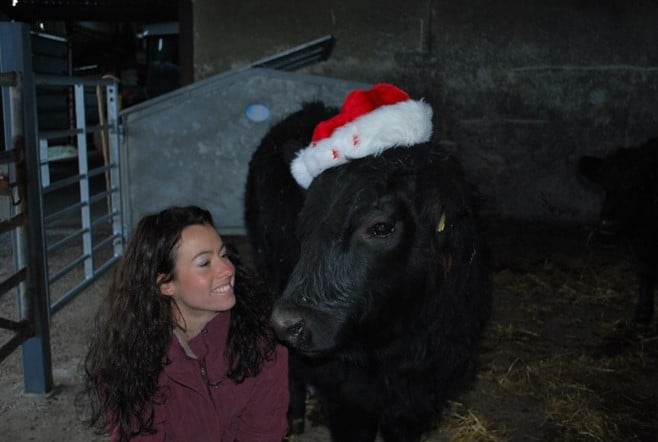
Left: A Sarah and Big B selfie! Middle: Beatrice with Sarah’s late father – well-known Welsh Black cattle breeder John Beynon FRAgS on Christmas Day 2014. John established the Tyddewi Herd of Welsh Blacks in 1976. Right: Sarah and Big B in 2014.
However, Richard also mentioned in his report that there were theoretically two surgical procedures possible, adding: “I would only be too happy to offer these, accepting my inexperience, but both are reported to have poor success rates in animals of Beatrice’s weight. I did encourage Sarah to seek opinions from large animal surgeons with personal experience of these procedures, though I am not entirely sure if any are currently active/available within the United Kingdom, or whether transport to one of them could ever be achieved”.
Richard sent Sarah a review paper on the subject and, being a research scientist herself, Sarah jumped on this, and decided to carry out her own literature review. “I told myself that if success rates in the literature was more than 10%, we would think about giving it a go” she said. Sarah quickly noticed the almost complete absence of information and saw that there were just a handful of American studies available. “As I was obviously very biased, I asked my colleague Tabitha Gibbons to review the literature for me and come back with some success percentages” she said. Sarah also asked her university friend, Animal Ethics writer and Veterinary Medicine publisher, Alice Oven, to review the data from an ethics perspective. “I wanted to ensure we were not putting B through too much by trying to save her” she said.
The results came back that Beatrice’s weight (a whopping 870kg) was against her, as all operative procedures were less successful in larger cattle. However, even in large bulls weighing over 900kg, the success rate of a CCL graft operation was 43% and Sarah decided that this figure was high enough to go for it. “I wrote a list of pro’s and cons for the pre-op practicalities around getting Beatrice to and from the equine hospital, the efficacy of the operation itself, the ethics, and the practicalities around the post-operative care. I think what really swung me was B’s attitude to life. She is determined, stoic, careful and calm. She copes well with being confined in a stable, can be led on a halter and will follow a bucket of food anywhere. We can also send her into a trance by scratching her with her favourite metal curry comb brush, which means we can give her injections without her even noticing! Whenever I used to walk into a field to try to groom one of the other cows, I would have to hide the comb behind my back or B would spot it and stomp over, using her large frame to push any other cow daring to be groomed out of the way and placing herself firmly in front of me to demand I groom her!”
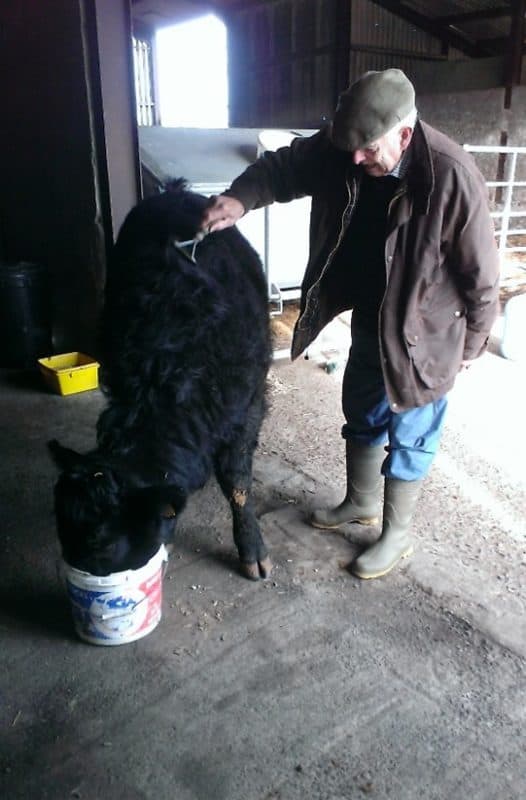
Beatrice and Sarah’s late father John Beynon – we know where Beatrice’s love of that metal curry comb stemmed from!
Richard and Sarah subsequently contacted many veterinary surgeons and vet schools across Europe, with seemingly endless discouraging replies. These were summed up by specialist bovine surgeon Dr Tanja Schmidt, based near Lucerne in Switzerland: “The cases I remember from my time in Zurich were slaughtered or euthanised because of poor-guarded prognoses and the unwillingness of the owners to provide the long box stall rest”.
The pair then looked further afield, contacting the authors of the papers in America – Andrew Niehaus at Ohio State University and Norm Ducharme at Cornell University. “When Professor Niehaus’s first response came back saying that he would advise euthanasia due to her size, I felt like I had been punched in the stomach” says Sarah. “However, he very kindly agreed to advise further if we were to go ahead and gave us wonderful advice on the operation procedure and post-operative care. Bizarrely, the only other person in the world who has published on this topic, Professor Norm Ducharme, is a friend of Richard’s. Professor Ducharme had operated on fourteen cows B’s size and published the 43% survival data, so it felt like we had found the oracle. As well as being very encouraging to operate on B, he observed in, as Richard commented was his usual dry manner: ‘As they say in the USA ‘the lord hates a coward’”.
Then the team then hit another hurdle: During surgery the new ‘graft’ ligament has to be threaded back through Beatrice’s knee joint to replace the torn cruciate ligament, using a giant steel curved needle called a graft passer. The size needed to do this in a big cow like Beatrice does not exist to order off the shelf like a regular surgical instrument. No-one in Europe clearly had use for one, whilst those described in the USA had been fabricated specially and were not available at short notice. However, in another fortuitous twist, a college friend of Richard’s, now living in Oregon, runs a specialist bicycle manufacturing company – English Cycles – and was able to step in. Despite being in the midst of a Pacific Northwest snowstorm, he was able to get into his workshop and fabricate the specialist s-shaped graft passer using a piece of stainless-steel rod formerly destined for a bicycle and, within 24 hours, send it on special delivery to the UK! Sarah recalls that: “The owners of Coppershell Animal Sanctuary in the UK, who are going through a similar situation with their steer Elton, sent over a screenshot of a US Facebook veterinary group chat where there was discussion about how a bicycle manufacturer wanted advice on how to make a piece of surgical kit to help save a cow in the UK – B was now internationally famous”.
Richard then called on an old friend for moral encouragement, Professor John Walmsley, a highly-respected, now retired, equine surgeon living nearby. They planned the procedure meticulously, before being kindly allowed to practise it several times at Tom Goddard & Son’s fallen stock yard. Richard said that this experience was “a steep learning curve of new anatomy, a vital piece of the jigsaw”. Further preparations followed during a Zoom meeting with Norm Ducharme, reviewing his many gory photographs of the real procedure and discussing the many critical steps. Finally, Richard felt as prepared as he was ever going to get to safely take on Beatrice’s surgery for real.
While Richard was researching the procedure, Sarah and Andy were flat-out organising the logistics. “Our fantastic fencers and shed builders Geraint Davies and Jack pulled out all the stops to mend the gable end of a shed and create a recovery pen for B in case she made it through and sand for the flooring was delivered just in the nick of time by local JCB contractor Dai Murphy” says Sarah. “Our great friend Angela spent many hours driving back and forth to both Fenton Vets and Cotts Equine Hospital to pick up medicines for B while we were sorting everything at home, so it really was a team effort!”
A week later, after having to keep Beatrice off food for thirty-six hours (no mean feat – as her vet Alex said: “Knowing Beatrice, this was probably the most stressful part for her”), a meticulously-planned mission (helped by the loan of a trailer from next-door neighbours Mark and Emma Evans, and mechanics working at the last minute at Glyn Thomas, Mathry) enabled Beatrice to be transported to Cotts Equine Hospital for her pioneering operation.
“B hobbled in and out of the trailer like a pro, past a horse having a tooth operation (whose eyes were covered with a coat to stop it seeing the big cow walking through a horse hospital) and into the induction room. With her trusty metal curry comb, we were able to send her into a trance while she was sedated and then Andy made sure he looked into her eyes to reassure her as she was anaesthetised before we left everything to the professionals” said Sarah.
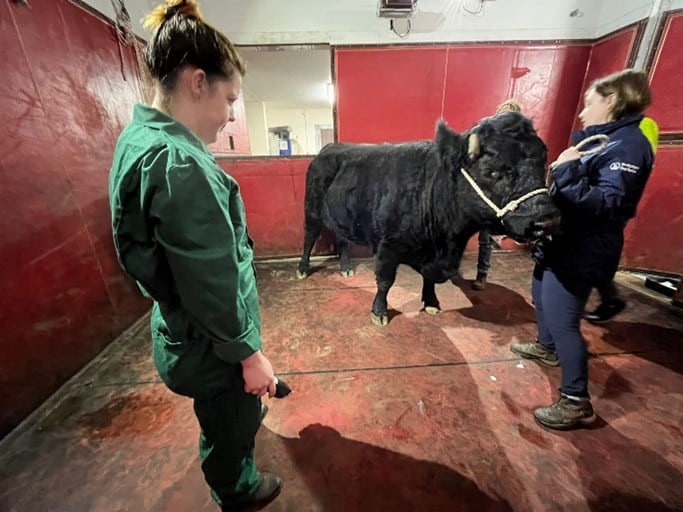
Beatrice getting ready for her operation at Cotts Equine Hospital (image by Cotts Equine Hospital).
“The four-hour operation was one of the longest four-hour periods of my life” recalls Sarah. When Alex came out of the viewing area after almost three hours to say it was going well and they were stitching her back up, the relief was overwhelming. Richard had managed to successfully complete the procedure and the next – very possible – worry was whether B had damaged the nerves on the front leg she had been lying on and whether she would be able to get up. “When Richard emerged, we were allowed to see a live feed of the recovery room and she was sitting up, which he told us was a wonderful first step. As we chatted, we heard Shaun, the anaesthetist saying: ‘She’s up’. At that point, I think we allowed ourselves to believe that she may make it and the happy tears started to flow”.
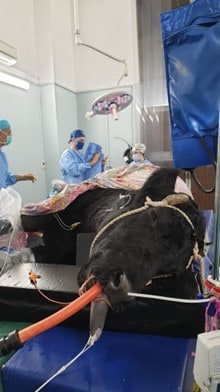
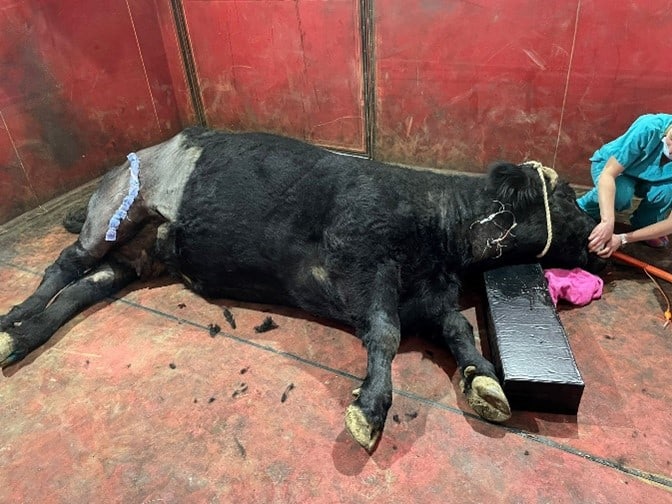
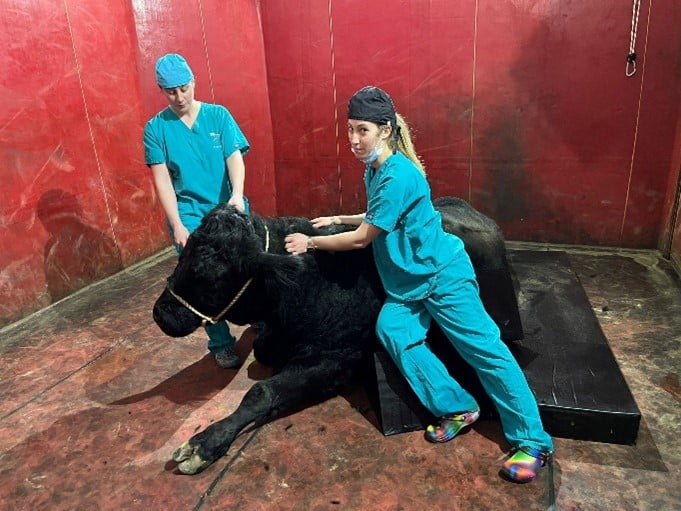
Left: Beatrice undergoing her operation at Cotts Equine Hospital. Middle: Beatrice immediately after her operation. Right: Beatrice sitting up after her operation (images by Cotts Equine Hospital).
“Going into the recovery room and seeing our big girl standing and swaying before turning to give us one of her special little moos was something I will remember forever” says Sarah. Incredibly, just half an hour later, Beatrice walked out of recovery, back into the trailer – past a donkey this time – to head home to The Bug Farm.
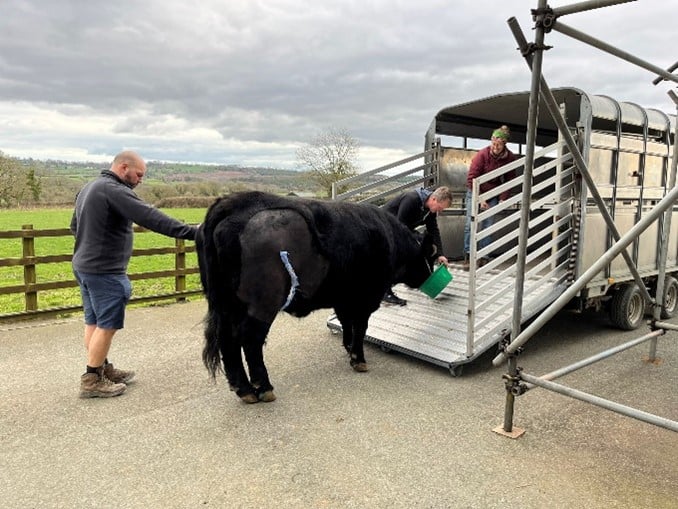
Beatrice’s vet Alex Cooper from Fenton Vets, with Sarah and Andy, loading Beatrice after her operation (image by Cotts Equine Hospital).
“She’s definitely not out of the woods yet” said Sarah, with the next hurdles for Beatrice to overcome being the very real threat of septic arthritis and the possibility that the graft doesn’t hold when she starts moving around. “We’re taking everything one step at a time. B didn’t want to eat, drink, pass urine or dung for the first day and so when we saw that first pile of dung and first gush of wee, we were ecstatic! She is doing well so far and we just have to do everything to make sure she continues to do well during her recovery. B now needs to be kept in a small stable for the next six to eight months as she heals and then, if she does, she will need to lead a quiet life for the rest of her days, as her graft will only be about 30% as strong as the ligament used to be. She’s coping – we provide in-house entertainment by rotating the goats and the ponies in the next-door pens and giving her plenty of cuddles and grooms every day”.
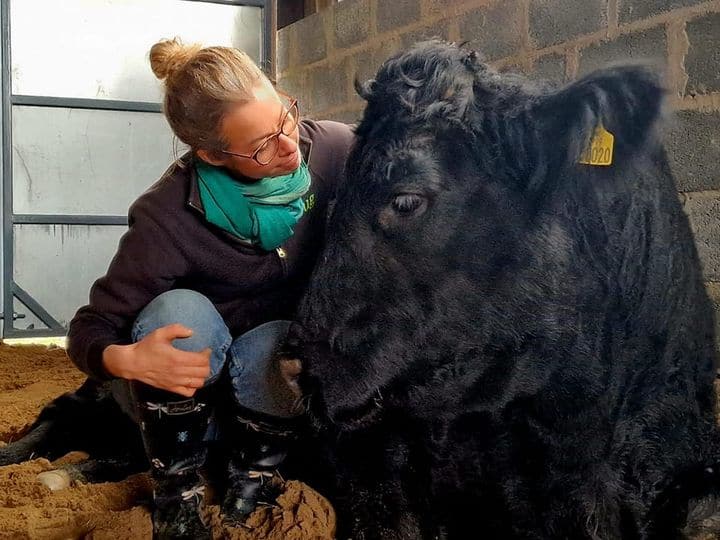
Beatrice back home with Sarah.
Sarah has been around Welsh Blacks all her life. She grew up on a beef cattle farm – indeed, Beatrice is the daughter (from stored semen) of Tyddewi William, the 1987 Welsh Black Bull of the Year, who was unbeaten in shows across the UK. Beatrice herself even dipped her toe into the showing world as a youngster. “The role of the herd now is to conservation-graze wildlife habitat to boost biodiversity and nature recovery” says Sarah. “Every animal, whether male or female, lives with us here for the whole of their lives and never leaves the farm – they’re stuck with us to the end and will never have to make the stressful journey to a slaughterhouse. They retire into a retirement herd living on less demanding terrain where they can be adored and pampered by us and our visitors” [The Bug Farm is also a visitor attraction].
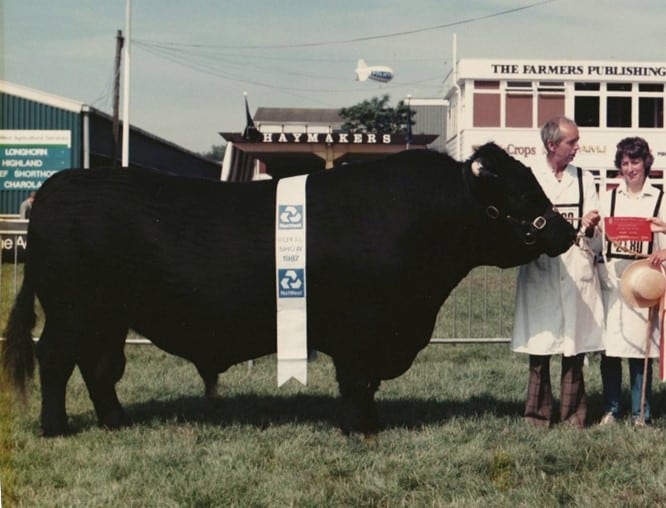
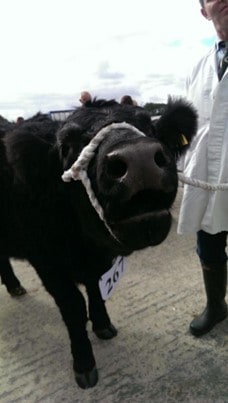
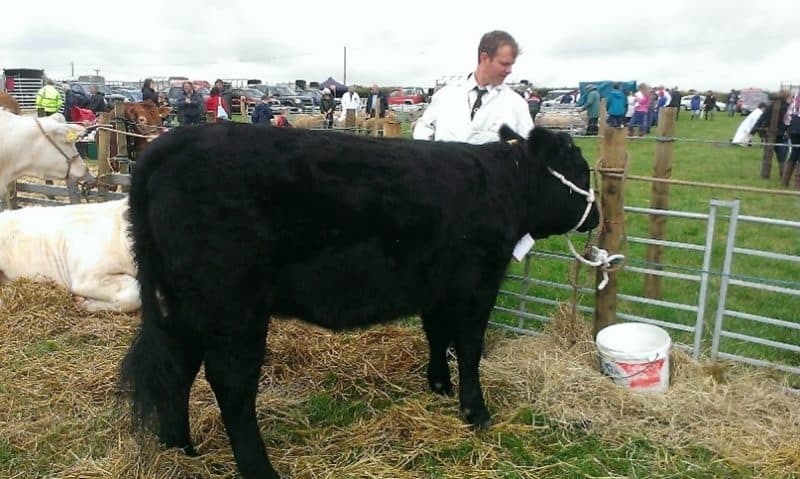
Left: Beatrice’s sire, Tyddewi William, at the Royal of England Show in 1987 with Sarah’s late parents John and Pauline Beynon. Middle: Beatrice at Pembrokeshire County Show with Andy. She always did have a strong personality! Right: Beatrice at Fishguard Show with Andy.
“I think that this just shows that if you care enough, never give up and bring good, kind people together, you can sometimes achieve the almost impossible” says Sarah. “I am so proud of B’s legacy already”. And Beatrice’s story led to some interesting moral questions: As Alice Oven says: “That Beatrice is a companion cow, not ‘livestock’ gave the ethics behind this surgery unique nuance. At no point did her ‘economic worth’ factor into the ethical decision-making process; instead, the decision was based on Beatrice’s welfare and her guardians’ deep understanding of her personal strengths and weaknesses. The field-defining success of the operation shows what can be achieved for veterinary medicine when we value animals as unique individuals”. Indeed, Dr Tanja Schmidt reiterated the importance of moving the science forward in this area: “Your patient Beatrice comes at a good time to get the head back into thinking about more demanding cases” said.
But Sarah is keen to explain that: “Operations like this are not just for ‘pet cows’. B’s operation costs, although significant, are in the low thousands and not tens of thousands, well within economic limits for many pedigree animals that are often sold for tens- if not hundreds of thousands of pounds. If we can advance the science and facilities here in the UK and in Europe, I think operations like this could save a lot of lives in the future”. In this incredible story, it is perhaps unsurprising that the graft passer that saved Beatrice’s life was made by a man who had his own pet cow who was loved very much and Sarah would like to dedicate this outcome to Peanut and to Beatrice’s best friend Maria, who they said goodbye to earlier this year. Sarah is now passionate to make sure that Beatrice can help other farm animals in need by advancing the science and outreach in this field. The Animal Rescue Foundation, of which Sarah is an ambassador, have kindly donated £2,500 to help Sarah look into ways to develop a non-for-profit to help Beatrice and the rest of her herd live their forever lives – valued for who they are and not what income they can bring to a business.
Posted November 2023